If you have been trying for a baby for a few months and nothing has happened, you have probably started to wonder whether something is wrong. Almost always, nothing is wrong — and the evidence says so quite clearly.
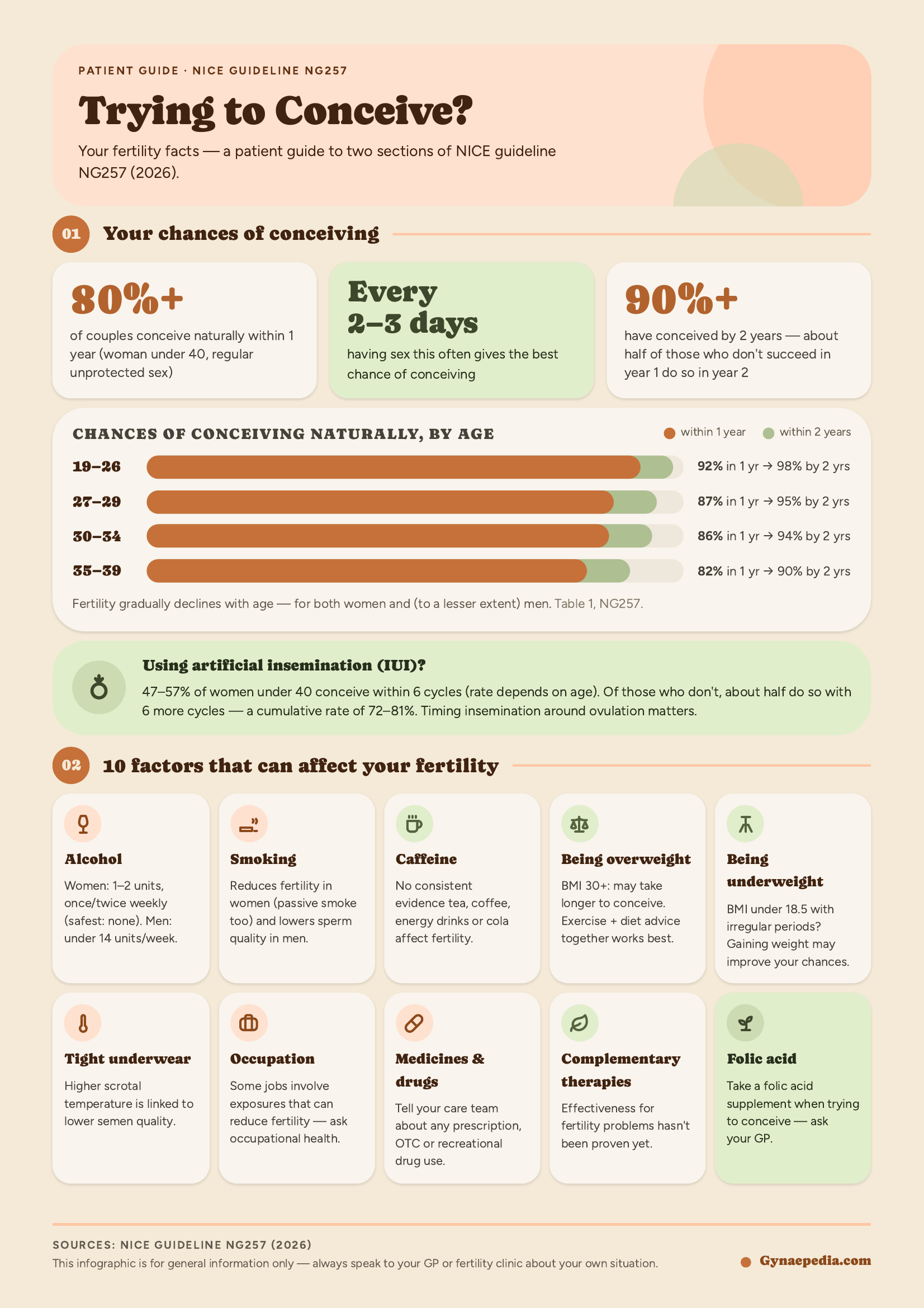
I have put together a summary of two sections of the latest NICE fertility guideline (NG257), covering how long conception usually takes, how that changes with age, and the ten factors that genuinely affect your chances — along with a few that people worry about unnecessarily.
The figure I would most like women to know is this one: of the couples who do not conceive in the first year, about half go on to conceive in the second year, with no treatment at all.
Download a print-quality copy
Keep it, print it, or share it with anyone who might find it useful.
When is it worth seeking help?
The general guidance is to seek advice after a year of trying, where there is no known reason to expect difficulty. It is sensible to ask sooner if you are 36 or over, if your periods are irregular or absent, if you have had pelvic infection, pelvic surgery or endometriosis, or if there is a known issue affecting your partner.
Fertility is a shared matter, and couples are best seen together — difficulties are found on the male side roughly as often as the female side. You can read more on my problems with conception page.
This is general information and not personal medical advice. Please speak to your GP or fertility clinic about your own situation.

